
If you own or rent a property, securing effective villa pest control in Dubai is essential because your home fights a completely different battle than an apartment does. Apartments have one entry level, shared walls, and a building management company handling common areas. A villa has none of that protection—it has a private garden, a driveway, a majlis, an outdoor kitchen, and irrigation lines running through the soil.
Why Villa Pest Control in Dubai Requires a Specialized Strategy
That combination is exactly why villa pest control in Dubai needs a completely different strategy than standard apartment pest control. A technician who sprays baseboards in a one-bedroom flat and calls it a day will barely scratch the surface of what a 4,000–8,000 sq ft villa plot actually needs.
At Eradicators, we’ve treated villas across every major Dubai community from the older Al Barsha and Mirdif homes with mature gardens, to newer developments like Dubai Hills Estate and Tilal Al Ghaf where landscaping is still settling in. This guide walks you through exactly what villa owners need to know in 2026: which pests are hitting which communities, what a proper villa treatment actually involves, how much it costs, and how to keep your investment protected year-round.
Why Villa Pest Control in Dubai Requires a Unique Strategy
A villa gives pests far more ways in, and far more places to hide once they’re inside. Consider everything an apartment simply doesn’t have: Villa Pest Control in Dubai
- A garden and soil perimeter — the single biggest termite and ant risk factor in Dubai. Termites travel through soil and can reach a structure completely undetected until damage is already done.
- Irrigation and sprinkler systems — constant low-level moisture around the foundation and flowerbeds, which is exactly what mosquitoes, silverfish, and termites are drawn to.
- A private garage and storeroom — common entry points for rodents, especially where garage doors don’t seal fully at ground level.
- A boundary wall connecting to neighboring plots — pests don’t respect property lines. If your neighbor has an untreated rodent or termite issue, it’s only a matter of time before it becomes yours too.
- Multiple floors and a roof void — pigeons, wasps, and bats can nest in roof spaces that go unchecked for years.
- Outdoor majlis and BBQ areas — food residue and evening lighting attract flying insects, ants, and cockroaches.
- A pool and pool pump room — dark, humid, and rarely inspected, making it a favorite hiding spot for cockroaches and spiders.
None of this exists in a typical apartment. It’s why a villa needs a full-property inspection inside, outside, underground where possible, and up into the roof space not just a quick indoor spray.
The 8 Pests Every Dubai Villa Owner Should Watch For
1. Termites — The Silent Structural Threat
Termites are the single most expensive pest problem a villa owner can face. Dubai’s warm climate and irrigated gardens create ideal conditions for subterranean termite colonies to travel from soil into wooden door frames, skirting boards, and roof timber. By the time you see mud tubes on an exterior wall or hollow-sounding wood, the colony has often been active for months. Villas built with timber-heavy interiors, older properties in Al Barsha, Mirdif, and Umm Suqeim, and homes near mature landscaping are at the highest risk. We recommend annual termite inspections regardless of whether you’ve seen any signs waiting for visible damage is the most expensive way to find out you have a problem.
2. Rodents (Rats & Mice)
Garages, gardens, and the gaps under garden walls give rats and mice easy access into villas that apartments simply don’t offer. Rodents chew through electrical wiring (a genuine fire risk), contaminate stored food, and multiply quickly a single pair can produce dozens of offspring within a few months. Villa rodent control needs perimeter proofing, not just indoor bait stations, since the entry point is almost always outside.
3. Cockroaches (German & American)
Kitchens, pool pump rooms, and drainage areas around a villa are prime cockroach territory. American cockroaches in particular thrive outdoors in Dubai villas — in garden drains, under AC units, and around irrigation boxes before making their way indoors through gaps under doors.
4. Garden Ants
Ants are usually the first sign of an underlying moisture or food source issue in villa gardens. While mostly a nuisance, certain ant colonies can also indicate conditions that attract termites, so treating them early matters.
5. Mosquitoes
Standing water in irrigation lines, plant pots, and pool covers turns a Dubai villa garden into a mosquito breeding ground within days, especially between April and October. This is one of the few pest issues that directly affects outdoor family time majlis evenings and garden play areas.
6. Wasps & Bees
Villa eaves, roof voids, and garden trees are common nesting spots. With children and pets using the garden regularly, an untreated wasp nest is a genuine safety concern, not just an inconvenience.
7. Bed Bugs
Larger homes with guest rooms, frequent visitors, and domestic staff quarters see bed bug introductions more often than people expect usually via luggage or secondhand furniture, not lack of cleanliness.
8. Pigeons & Birds
Flat villa roofs, balconies, and parapet walls are popular pigeon roosting spots across Dubai. Beyond the mess, accumulated droppings pose a genuine health hazard and can damage roofing membranes over time.
Villa Pest Control by Dubai Community: What We’re Seeing on the Ground
Because we treat villas across the entire city, we see clear patterns by community. Here’s what villa owners in each major area should be watching for:
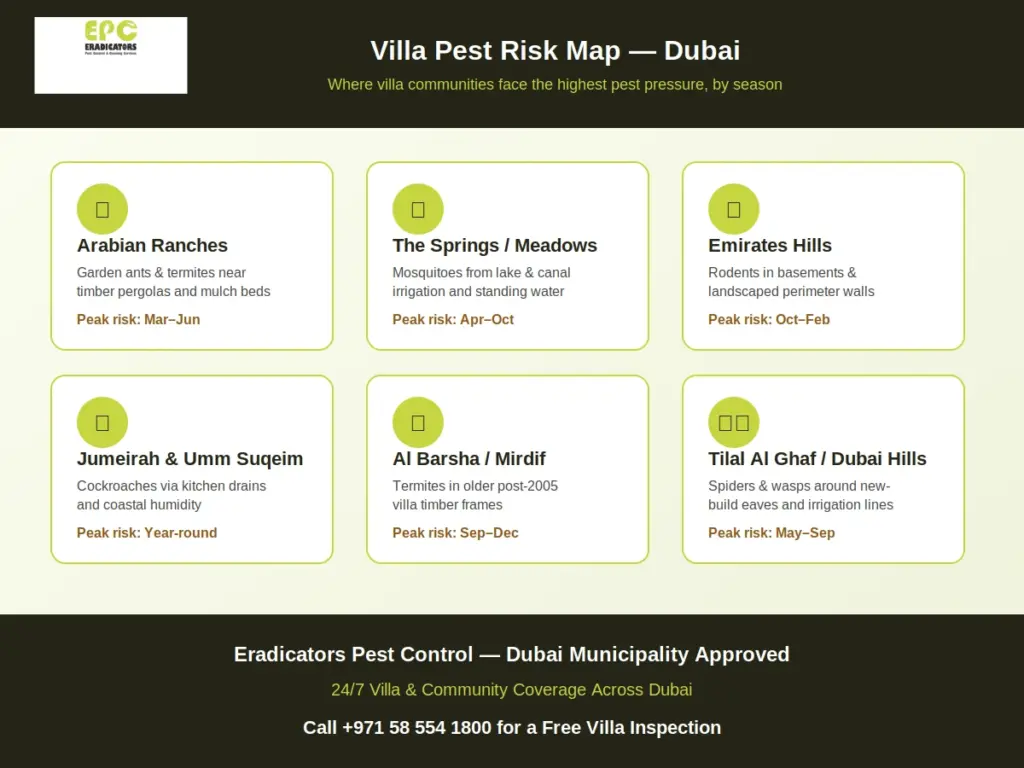
Arabian Ranches & Arabian Ranches 2 — Mature landscaping, timber pergolas, and mulched flowerbeds make this one of the highest-risk communities for garden ants and termites. Spring and early summer (March–June) see the sharpest spike in activity.
Emirates Hills — Larger plots and expansive perimeter walls mean rodent activity is the top concern here, particularly in basement levels and around landscaped boundaries during the cooler months (October–February).
The Springs & The Meadows — Lake-adjacent villas face consistently higher mosquito pressure thanks to nearby water features and irrigation. Screening and larviciding around standing water are essential from April through October.
Jumeirah & Umm Suqeim (villa clusters) — Coastal humidity plus older kitchen plumbing make cockroaches a year-round issue rather than a seasonal one.
Al Barsha & Mirdif — Many of these villas were built in the early-to-mid 2000s with more timber in door frames and roof structures, putting them at higher termite risk, especially heading into the cooler September–December period when subterranean colonies expand activity.
Tilal Al Ghaf & Dubai Hills Estate — Newer developments with fresh landscaping and irrigation systems still settling in tend to see more spiders and wasps nesting around eaves and garden structures during the hotter months (May–September).
Jumeirah Village Circle (JVC) Villas & Townhouses — Dense, closely-packed villa clusters mean pest problems travel fast between neighboring units ant trails and rodent activity in particular spread quickly through shared walls and gardens.
Ras Al Khaimah Villas — Similar risk profile to Dubai’s outer villa communities, with termite and rodent pressure being the two most common call-outs we receive.
Wherever your villa is located, the underlying principle is the same: outdoor conditions drive indoor infestations. Treating only the interior of a villa without addressing the garden, perimeter, and drainage is why so many villa owners tell us “we had it sprayed and the pests came right back.”
What Professional Villa Pest Control in Dubai Should Cover
If you’re comparing quotes, here’s the checklist a genuinely thorough villa treatment should cover not every provider does all of this, and it’s worth asking directly:
- Full exterior perimeter treatment — foundation line, boundary walls, and garden beds, not just the house itself.
- Interior treatment room-by-room — kitchen, bathrooms, storage, maid’s room, and any ground-floor living areas.
- Garage and storeroom inspection — the most common overlooked entry point for rodents.
- Pool pump room and drainage check — a favorite hiding spot that’s rarely inspected during a standard visit.
- Roof void and eaves check — for wasp nests, pigeon activity, and roof-line termite access.
- Irrigation and standing water assessment — to identify mosquito breeding points before they become a problem.
- Termite-specific inspection — including soil treatment options for properties with an active or historical termite risk.
- A written report with a treatment plan — not just a verbal “all done,” so you have a record for future reference or property resale.
- A follow-up or warranty period — reputable villa pest control includes a guarantee that if pests return within a set window, the company comes back at no extra charge.
How Much Does Villa Pest Control in Dubai Cost?
Villa pest control pricing depends on plot size, the number of pests being treated, and whether it’s a one-off visit or an annual maintenance contract. As a general guide:
- Standard villa treatment (general pests): typically ranges based on villa size a 3-bedroom villa costs less than a 6-bedroom villa with a larger garden footprint.
- Termite treatment: priced separately and usually includes a multi-year warranty given the scale of soil and structural treatment involved.
- Annual maintenance contracts: the most cost-effective option for villa owners, since quarterly visits catch problems early rather than waiting for a full infestation to develop.
For an accurate number, a free on-site inspection is always more reliable than a phone quote — plot size, garden density, and existing conditions all affect the final price.
DIY vs. Professional Villa Pest Control: Where the Line Is
Store-bought sprays and traps can manage the occasional stray ant or single mosquito problem. But for the pests that actually threaten a villa termites, established rodent populations, or a wasp nest in a roof void DIY treatment usually does one of two things: it pushes the problem to a different, harder-to-reach part of the property, or it treats the visible symptom while the actual colony or nest keeps growing untouched.
Termite treatment in particular requires products and application methods that aren’t available to the public and require Dubai Municipality approval to use. This is the one category where DIY isn’t a cost-saving option it’s a way of delaying an expensive problem while it gets worse underground.
Frequently Asked Questions
How often should a Dubai villa get professional pest control? For most villas, a quarterly maintenance visit strikes the right balance frequent enough to catch new activity early, especially around seasonal spikes, without being excessive. Villas with mature gardens, a history of termites, or properties near canals and lakes often benefit from more frequent monitoring.
Is villa pest control safe for children and pets? Yes, when handled by a Dubai Municipality-approved company using low-toxicity, family-safe products. Ask your provider directly what re-entry time is recommended after treatment, and make sure outdoor treatments are pet-safe if you have dogs or cats using the garden.
Do I need to leave the villa during treatment? Usually not for standard interior and exterior treatment. Termite soil treatment or heavy infestation fumigation may require a short period away from treated areas your technician will confirm this before starting.
What’s the difference between villa and apartment pest control? Villa treatment covers a much larger physical footprint garden, perimeter, garage, roof void, and pool area that simply doesn’t exist in an apartment. It also needs to account for termite and rodent risks that come specifically from ground-level soil access, which apartments above ground level don’t face in the same way.
How do I know if I have termites and not just ants? Termites typically leave mud tubes along foundations or walls, and damaged wood often sounds hollow or looks blistered rather than simply having visible insects crawling on the surface. If you’re unsure, a professional inspection is the safest way to confirm misidentifying termites as ants (or vice versa) is one of the most common and costly mistakes villa owners make.
Protect Your Villa Investment Today
Your villa is one of the biggest investments you’ll make in Dubai and pests, particularly termites and rodents, can quietly damage that investment long before the visible signs show up. A proper villa pest control plan isn’t just about comfort; it’s about protecting the structure, the resale value, and your family’s health.
Eradicators has been serving Dubai villa communities from Arabian Ranches Emirates Hills to Al Barsha, Mirdif, The Springs, Jumeirah, Dubai Hills, and Tilal Al Ghaf with Dubai Municipality approved, family and pet safe treatments and a 100% eradication guarantee.
Book your free villa inspection today: call or WhatsApp +971 58 554 1800, or email info@eradicators.ae.
Suggestions :
- Link “termites” → /best-termites-pest-control-in-dubai/
- Link “rodents / rats and mice” → /rodent-pest-control-dubai/
- Link “cockroaches” → /cockroaches-pest-control-dubai/
- Link “mosquitoes” → /mosquitoes-pest-control-dubai/
- Link “wasps” → /wasps-bees-pest-control-dubai/
- Link “Arabian Ranches” → /pest-control-arabian-ranches/
- Link “Emirates Hills” → /pest-control-emirates-hills/
- Link “The Springs” → /pest-control-the-springs-dubai/
- Link “Jumeirah Village Circle (JVC)” → /pest-control-jumeirah-village-circle-jvc/
- Link “Contact / free inspection” CTA → /contact-pest-control-dubai/