
Mosquitoes Pest Control in Dubai - How Dubai Mosquitoes Breed, Bite & How We Stop Them
If you are looking for mosquitoes pest control in Dubai, you already know that living in a desert city does not keep mosquitoes away. Many residents are surprised to get bitten indoors in January, around villa pools in April, or on high-rise balconies after a brief winter rain. That happens because urban Dubai creates thousands of hidden micro-habitats—air-conditioning condensation trays, automated garden drip irrigation, basement drainage sumps, plant-pot saucers, and decorative water features that allow mosquitoes to breed nearly year-round.

At Eradicators Pest Control & Cleaning Services (operating in Dubai since 2016 from our office in Al Habtoor Business Tower, Dubai Marina), we don’t just walk through your garden with a noisy fogging machine that wears off in 48 hours. Our Dubai Municipality-approved technicians use science-backed Integrated Mosquito Management (IMM): locating the exact water source where larvae are hatching, disrupting their 4-stage life cycle with targeted larvicides, and applying family- and pet-conscious barrier treatments around resting foliage.
Call or WhatsApp: 058 554 1800 | Email: info@eradicators.ae | 24/7 Booking Enquiries
What Are Mosquitoes and How Does Their 4-Stage Life Cycle Work?
Understanding how mosquitoes reproduce explains why store-bought coils, plug-in diffusers, and one-off surface sprays rarely solve an infestation:
Stage 1 : Eggs (1 to 3 Days, or Dormant for Months): Only female mosquitoes bite, because they need protein from blood to develop eggs. Depending on the species, a single female lays 100 to 300 eggs at a time on or just above stagnant water. Remarkably, Aedes mosquito eggs can survive completely dried out for months stuck to the inside of an empty plant saucer or bucket—and hatch the moment rain or irrigation water touches them.
Stage 2 : Larvae / “Wrigglers” (4 to 7 Days): Eggs hatch into aquatic larvae that live in water and breathe through a tiny siphon tube at the surface. This is the single easiest and safest stage to eliminate, because larvae are trapped inside a specific water source and haven’t grown wings yet.
Stage 3 : Pupae / “Tumblers” (1 to 2 Days): Pupae are comma-shaped cocoons floating near the water surface. They do not feed, which means chemical sprays don’t affect them well—another reason early larval control matters.
Stage 4 : Flying Adults (2 to 4 Weeks): Once an adult emerges, it rests in cool, shaded, humid spots under dense garden hedges, behind outdoor curtains, under patio furniture, and inside bathroom or laundry corners before flying out to feed and lay the next batch of eggs.
The Dubai Heat Accelerator: In cooler climates, this cycle takes 2 to 3 weeks. In Dubai’s warm spring and autumn weather, eggs can become biting adults in as little as 7 to 10 days. Even one bottle-cap or saucer of water (less than 1 cm deep) is enough to hatch dozens of mosquitoes.
Why Does Dubai Have Mosquitoes in a Desert Climate?
Dubai’s natural desert climate is dry, yet modern residential and commercial infrastructure provides constant artificial water and shelter:
Air-Conditioning (AC) Condensation: Every split AC unit, chiller tray, and balcony drain line produces continuous condensation water even during peak July and August heat when natural rainwater is zero.
Automated Villa & Community Irrigation: Daily drip lines and sprinklers in landscaped villa gardens saturate soil, fill sunken valve boxes, and pool inside decorative planters and stone edging.
Seasonal Rain & Humidity Spikes: After winter or spring rainstorms, thousands of dormant Aedes eggs in roof gutters, construction trenches, and courtyard drains hatch simultaneously causing sudden citywide surges about 7–10 days later.
Open Windows in Pleasant Weather (November – April): During Dubai’s cooler months, residents open balcony doors and terrace sliders in the evening, inviting dusk- and night-biting mosquitoes straight into bedrooms and living rooms.
High-Rise Podiums & Basement Sumps: Even on the 25th floor of a tower, mosquitoes breed in basement car-park drainage pits, garbage-room wash drains, and landscaped podium planters, then ride air currents and elevator shafts upward.
The 3 Main Mosquito Species in Dubai (And Why Knowing Which One Matters)
Not all mosquitoes bite at the same time or breed in the same water. Identifying the species tells our technicians exactly where to look:
1. Aedes aegypti - The Daytime-Biting Striped Mosquito
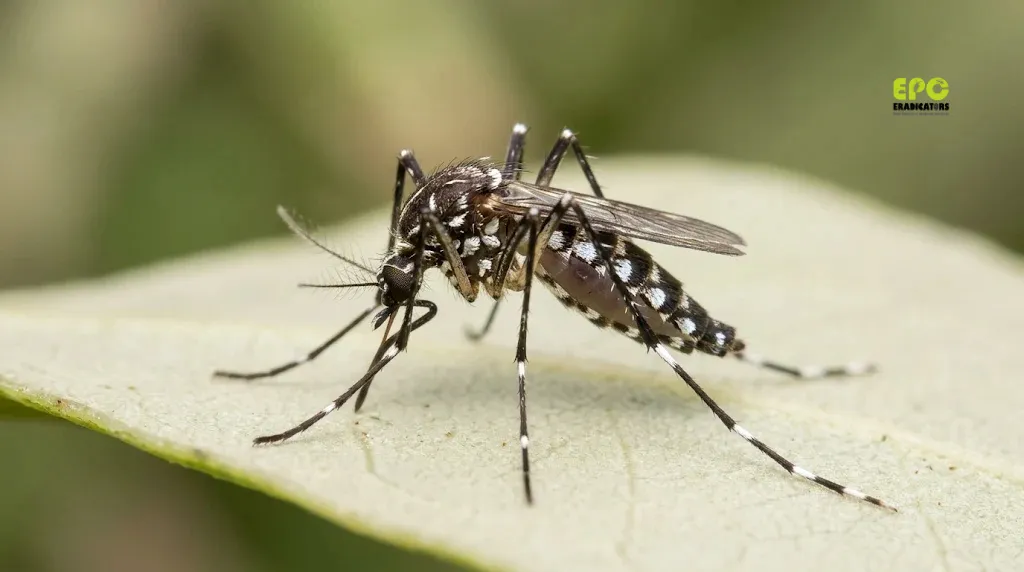
How to Spot It: Small, dark mosquito with distinctive white-and-black striped legs and markings.
When It Bites: Primarily during daylight hours (roughly 8:00 AM to 5:00 PM), especially around ankles and elbows outdoors or near shaded patios.
Where It Breeds: Clean, small artificial containers plant-pot saucers, AC drip trays, pet water bowls left unwashed, flower vases, and roof gutters.
Health Relevance: Aedes mosquitoes are the primary vectors watched by UAE health authorities for dengue fever and chikungunya.
2. Culex quinquefasciatus - The Common Night-Biting House Mosquito
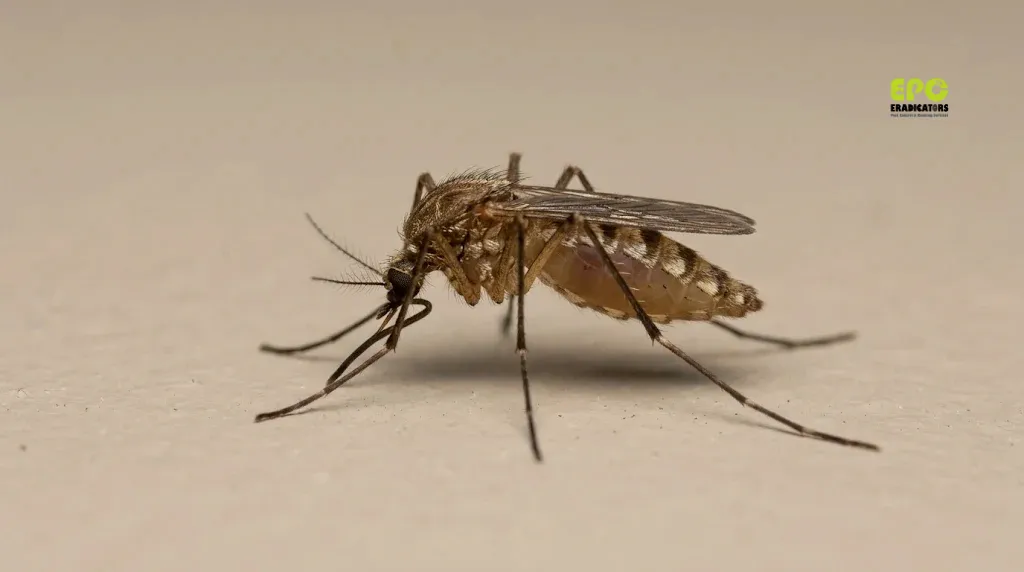
How to Spot It: Plain brown-to-tan body with a faint banded abdomen and a noticeable high-pitched buzz near your ears at night.
When It Bites: From dusk through dawn, often sneaking indoors through open balcony doors or unscreened vents.
Where It Breeds: Larger volumes of stagnant water containing organic matter—blocked floor drains, irrigation chambers, septic/greywater sumps, neglected fountains, and stagnant ponds.
Health Relevance: Culex species are known vectors for West Nile virus and cause the majority of indoor night-time sleep disruption in Dubai apartments and villas.
3. Anopheles Species - The Dusk & Peri-Urban Biter
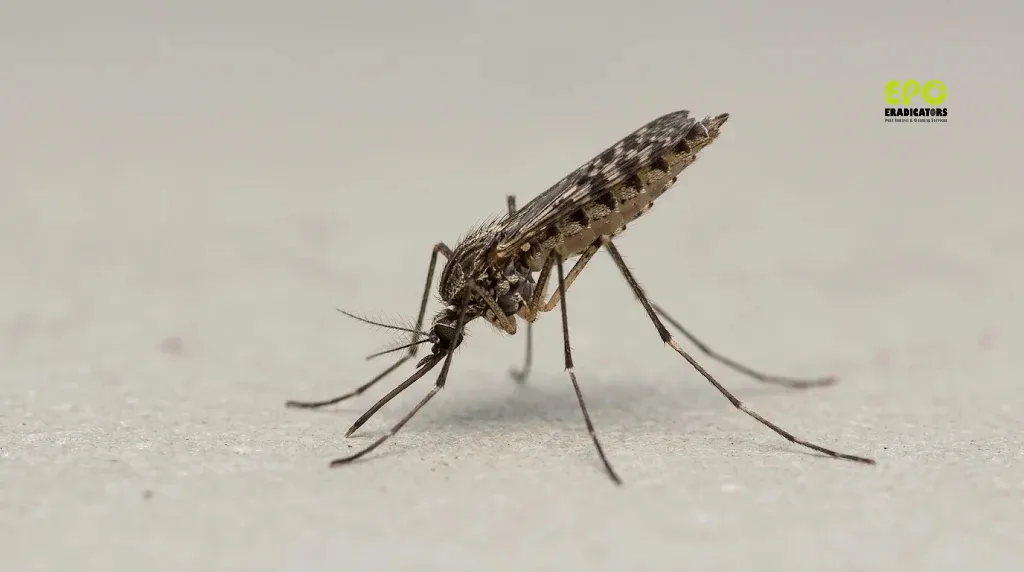
How to Spot It: Rests with its body tilted at an angle (almost head-down) rather than parallel to the wall.
When It Bites: Dusk and night.
Where It Breeds: Larger, sunlit or semi-shaded water collections, irrigation canals, and outer-community water basins. Globally, Anopheles mosquitoes are the vector associated with malaria.
Why Fogging Alone Fails for Mosquitoes Pest Control in Dubai
Many homeowners call a pest control company expecting a quick cloud of white thermal fog across the garden. While thermal fogging or ULV misting knocks down flying adult mosquitoes on contact, it does not kill eggs or larvae sitting inside water drains or irrigation boxes and it evaporates quickly in Dubai’s breeze. Within 3 to 5 days, the next batch of larvae hatches and the biting starts all over again.
At Eradicators, we solve the whole cycle using a 4-Step Integrated Mosquito Management (IMM) protocol:
Breeding-Site Audit & Source Mapping: We inspect every indoor and outdoor water point—AC trays, balcony floor traps, plant saucers, swimming pool skimmers, fountain basins, irrigation valve boxes, and roof gutters.
Targeted Larvicide Treatment: Where standing water cannot be drained immediately (such as storm drains, sump pits, or irrigation chambers), we apply Dubai Municipality-approved larvicides / Insect Growth Regulators (IGRs) or biological Bti treatments that stop larvae from ever becoming biting adults—without harming garden plants or non-target wildlife.
Resting-Zone Barrier Spraying & ULV / Thermal Fogging: Because adult mosquitoes spend 90% of their day resting on the underside of dense leaves, shaded hedges, boundary walls, and under patio decking, we apply targeted residual barrier treatments to those exact resting surfaces (and use ULV cold-misting or thermal fogging where rapid knockdown is needed).
Exclusion & Prevention Plan: We show you which drains need fine mesh covers, which irrigation zones are over-watering, and how to break the weekly breeding cycle permanently.
Dubai Areas, Villa Communities & Residential Towers We Serve
Our mobile mosquito-control teams operate across every major neighbourhood in Dubai, tailoring treatments to each area’s specific water and landscaping risks:
Lakeside & Irrigated Villa Communities: The Springs (Springs 1–15), The Meadows, The Lakes, Emirates Hills, Jumeirah Islands, Jumeirah Park, Arabian Ranches (1, 2 & 3), Dubai Hills Estate (Sidra, Maple, Golf Place), DAMAC Hills & DAMAC Hills 2, Tilal Al Ghaf (Harmony, Aura, Elora), Mudon, Town Square, Reem / Mira, Al Furjan, and Victory Heights. (Focus: irrigation valve boxes, pool pump rooms, dense hedges, and lakeside evening biting.)
Coastal & Waterfront Residences: Palm Jumeirah (Fronds A–P, Shoreline Apartments, Golden Mile, Marina Residences), JBR (Murjan, Sadaf, Bahar, Rimal, Amwaj, Shams), Dubai Marina (Princess Tower, Marina Gate, Cayan Tower, Damac Heights), Bluewaters Island, Jumeirah 1–3, Umm Suqeim, and Dubai Creek Harbour. (Focus: coastal humidity, balcony planters, AC drain trays, and terrace dining protection.)
High-Rise & Mixed-Use Districts: JLT (Jumeirah Lakes Towers Clusters A–Z), Business Bay (Executive Towers, Damac Towers by Paramount, Merano), Downtown Dubai (Burj Views, Boulevard Point, Old Town), JVC (Jumeirah Village Circle Districts 10–18, Binghatti, Belgravia, Bloom Towers), Dubai Silicon Oasis, Discovery Gardens, Al Barsha, Mirdif, and Motor City / Sports City. (Focus: podium planters, basement drainage sumps, and balcony/window exclusion.)
Commercial, Hospitality & Outdoor Venues: Beachfront resorts, hotel pool decks, al-fresco restaurants, nurseries, schools, warehouses, and labour accommodations across Al Quoz, Jebel Ali, DIP, and DIFC.
(Note: For public roads, public parks, sewage treatment plants, and municipal storm drains, Dubai Municipality’s Public Health Pest Control Section handles citywide public-area vector control reachable via 800 900. Inside private villas, gardens, apartments, and commercial plots, licensed private companies like Eradicators provide targeted inspection and treatment.)
Family, Pet, Pool & Garden Safety for Mosquitoes Pest Control in Dubai
Because mosquito treatments take place where children play and families dine outdoors, safety comes first:
Kids, Pets & Outdoor Bowls: Before any garden or terrace application, we ask you to move pet water bowls, dog toys, and children’s outdoor items indoors and keep pets inside until treated foliage and patios are completely dry.
Fish Tanks, Koi Ponds & Swimming Pools: Always inform our technician before arrival if you have koi ponds, backyard aquariums, pet birds, or pool-side water features so we protect water surfaces and use non-aquatic-toxic options where required.
Indoor Treatments: If indoor residual spraying is needed around entry hallways or utility rooms, we advise a minimum 4-hour vacancy period until surfaces dry and rooms are aired out, following Dubai Municipality and product-label instructions.
Learn more about our pet-friendly pest control in Dubai.
Practical Weekly Prevention Checklist for Dubai Residents
Combine professional mosquitoes pest control in Dubai with these simple weekly habits to cut mosquito numbers dramatically:
Every Week: Scrub and empty plant-pot saucers (eggs stick to dry edges, so wiping them removes dormant eggs), refresh outdoor pet bowls, and clear fallen leaves from terrace drains.
Every Month: Check and flush balcony AC condensation drip lines and inspect garden irrigation valve boxes for pooled water or leaking joints.
Before Cooler Evenings: Repair torn window and sliding-door fly screens, and add fine mesh covers over outdoor floor traps.
For Villas & Outdoor Venues: Schedule preventive larvicide and barrier maintenance ahead of peak spring (March–May) and autumn/winter (October–December) outdoor seasons.
Mosquitoes Pest Control in Dubai: Transparent Pricing & Maintenance Options
Your mosquito control quote depends on what your property actually needs never a deceptive flat teaser price:
Apartments & Terraces: Priced by apartment size, balcony planters, and drain/AC-tray inspection.
Villas & Landscaped Gardens: Priced by plot size, garden density, pool/water-feature count, and whether larviciding plus barrier misting is required.
One-Time Treatment vs. Seasonal / Annual Plans: Single visits handle sudden post-rain spikes, while monthly or quarterly AMC plans keep villa gardens, lakeside homes, and outdoor restaurants comfortable all season.
Read our Dubai pest control pricing guide or compare our pest control subscription & AMC plans.
Reclaim Your Garden, Balcony & Bedrooms From Mosquitoes
Targeting Aedes, Culex & Anopheles breeding sites across all Dubai villas, apartments & outdoor venues • 24/7 booking enquiries.
Frequently Asked Questions - Mosquitoes Pest Control in Dubai
1. Why am I getting bitten by mosquitoes during the daytime in Dubai?
Daytime biting (especially between 8:00 AM and 5:00 PM around ankles and arms) is classic behaviour of the Aedes aegypti mosquito. Unlike night-biting Culex mosquitoes, Aedes breeds in tiny amounts of clean water such as plant saucers, AC trays, and roof gutters, and rests in shaded patio areas.
2. Why do mosquitoes come back a few days after garden fogging?
Thermal fogging only kills flying adult mosquitoes present at that exact moment. It does not kill eggs or aquatic larvae developing inside irrigation boxes, drains, or plant saucers. Without larvicide treatment and breeding-site removal, new adults emerge within days.
3. Are there mosquitoes in Dubai even during peak summer?
Yes. While extreme midday summer heat reduces daytime outdoor flying, AC condensation drip trays, basement sumps, and irrigated villa gardens keep mosquitoes breeding all summer especially along humid coastal areas like Palm Jumeirah, JBR, and Dubai Marina.
4. Is mosquito control safe for dogs, cats, babies, and garden plants?
Yes, when applied correctly. We use Dubai Municipality-approved products, target resting foliage rather than spraying indiscriminately, keep pets and children indoors until outdoor surfaces dry, and protect koi ponds, pools, and aquariums.
5. Can mosquitoes enter high-floor apartments in Dubai Marina, JLT, or Downtown?
Yes. Mosquitoes can breed on podium gardens, balcony planters, or basement drainage sumps and travel upward via elevator shafts, stairwell drafts, and open balcony doors.
6. When is mosquito season worst in Dubai?
Mosquitoes are active year-round, but biting complaints spike most noticeably in spring (March–May), autumn/early winter (October–December) when windows stay open, and 7 to 10 days after any rainstorm.
7. What is the difference between Dubai Municipality mosquito control and a private service?
Dubai Municipality (800 900) manages public areas—roads, parks, wastewater plants, and municipal storm drains. Homeowners, tenants, and businesses hire licensed private companies like Eradicators for inside private villas, gardens, apartments, and commercial properties.
8. How long does a professional mosquito treatment take?
Most apartment and terrace treatments take 30 to 45 minutes, while villa garden inspections, larviciding, and barrier treatments typically take 60 to 90 minutes depending on plot size.
9. Can you treat outdoor restaurants, nurseries, and hotel pool decks?
Yes. We schedule discreet early-morning or after-hours larvicide and barrier treatments for F&B terraces, hotels, schools, and nurseries across Dubai so guests and children are never disrupted.
10. How do I book mosquito pest control in Dubai with Eradicators?
Call or WhatsApp 058 554 1800 (or email info@eradicators.ae) with your Dubai area, property type (apartment, villa, or commercial), and where you notice biting, or book pest control in Dubai online anytime.